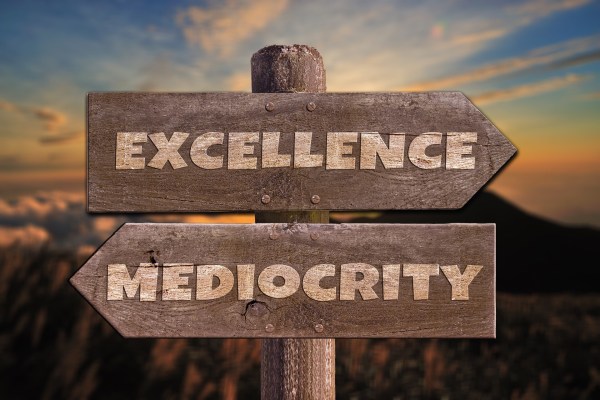
Why settle for mediocre? Aim to make your people outstanding

It’s that time of year for me when I’m talking to people about performance over the last six months. 

Committed to helping people be the best they can be and also to delivering maximum value with public funds, this is a process I’ve spent much time considering in order to ensure it delivers for the individuals I support.
My quest for perfection in performance management, has led to a number of steps that can provide a framework within which individuals can develop and deliver for your organisation.

Setting clear objectives is the first task if you want to create an environment where people can succeed. This step should provide clear direction in line with the organisation’s aims and ensure that person can meet their goals in a timely manner and know when the objective has been achieved. In particular, agreeing objectives which are SMART brings clarity to plans and ensures they can be completed within an agreed timeframe.

After this stage, it is important to work with the individual to agree what ‘good’ looks like. I’m not sure it’s possible for individuals to really excel in delivering their priorities if you haven’t discussed exactly what is required. Setting out expectations clearly from the beginning allows people to go the extra mile to ensure a high standard.

In observing performance management in a number of organisations, I’ve noticed that reviews too often become a process that people have to go through with little awareness of what they are about (see what’s wrong with performance management and annual reviews). In many cases, managers set objectives and sign off progress without much thought or discussion.

For me, it’s about creating a structure for people to succeed with a focus on encouraging and supporting them to exceed expectations. It seems to me that managers should consider it a priority to ensure their people are encouraged able to become ‘outstanding’ and concentrate their efforts on achieving this goal. I’m sure all organisations desire to have high performing teams so let’s stop thinking that mediocre is good enough and give people something to aim for.

Finally, I don’t believe that performance conversations looking back over a six month period go far enough to provide focus and motivation. Whilst my objectives might be set annually, I set out my plan to achieve them by looking forward over a three month period and reviewing progress on a monthly basis. This ensures the thinking time and prioritising which is necessary to make an impact. I’m then able to look back and see if I have achieved my goals, ensure my time is spent on the right things and to know if my objectives are the right ones.

As the year comes to a close, I wonder how your teams have performed over the last twelve months and offer a challenge to all of you to make a commitment for the new year to adopt a system that allows your people to shine in 2017.

3minuteleadership.org

Governance principles are recipe for success

Over the last few years, I have become particularly interested in the way that charities ensure effective governance. Most of us are familiar with the disaster surrounding kids company and the blatant mis-spending of public funds. If you are based outside of Wales, you may be less familiar with AWEMA who had similar issues and Trustees were criticised for not having the right safeguards in place. These cases have helped to place a spotlight on the charitable sector and made it even more important that robust governance procedures are in place.

For those readers who are totally new to the concept of governance in this context, the term is defined by the Charity leader’s network ACEVO as ‘systems and processes concerned with ensuring the overall direction, effectiveness, supervision and accountability of an organisation’.

Achieving ‘good governance’ requires the appropriate systems to be in place and the right people to be around the table. The current governance code sets out 6 key principles which focus on individual performance, suggesting that a Board room of individuals that can contribute fully according to these principles is what is needed for success.

Here are the 6 principles explained:

1) Understanding your role – the first requirement is that Trustees know what role they play in the process, what is expected of them and how they can make a full contribution.

2) Ensuring delivery of your organisational purpose – a charity Trustee must ensure funds are used to deliver the mission and that the very greatest value is achieved for every pound.

3) Work effectively as an individual and as a team – diversity has been talked about a lot in the ‘good governance’ debate and it’s not just about diversity of backgrounds but also a mixture of different viewpoints. To be effective, Trustees must be able to contribute their view as an individual but also respect the views of others and be able to support the overall decision.

4) Exercising effective control – it takes particular skill to exercise control without being controlling. The word ‘control’ gives an instant feeling of hierarchy which is not the aim here. What it means in this context is to ensure risk is managed effectively, financial controls are in place and the right questions are asked which hold those with responsibility to account.

5) Behaving with integrity – being honest and acting in a way that is guided by strong moral principles. As a charity Trustee, its likely that a strong sense of values is present and as such, decisions should be guided by a belief in what is right and proper.

6) Being open & accountable – this means to be clear about the decisions that have been taken and the reason for the board’s position. Being accountable might also require you to stand by your decision when challenged because you believe it is in the best interests of the organisation.

Building on this good practice, a new code of governance is out for consultation. The revised code reflects concerns about governance and responds to aspirations across the charitable sector to improve it. As a result of such high profile cases of mis-management, the new code places more emphasis on leadership, values, accountability, transparency and diversity. Its aim is for charity boards to maintain a strategic focus, ensure Board development and pursue charitable objectives.

To read the new code and respond to the consultation, click here


3minuteleadership.org

Adopting a coaching approach

Coaching is an important and valuable skill for leadership today and is a useful tool for developing people in your team.

I’ve found that by asking questions and helping individuals to think things through, they have a much deeper understanding of the issue. Compare that with a situation where you tell them the answer, you can’t be sure they have grasped the point you are trying to make.

This approach has been extremely useful in ensuring my team knows how their work fits with the bigger picture and what we are trying to achieve. Not what the job is that must be done but what the task is designed to achieve and how we can make this happen.

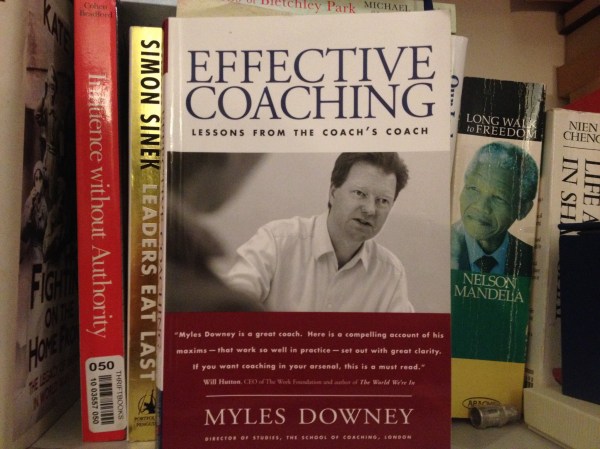
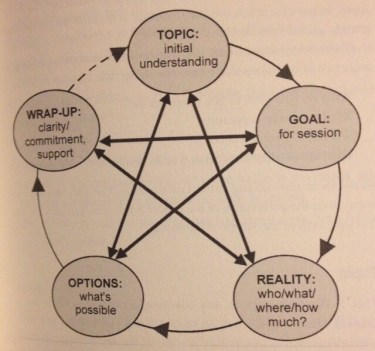
One of my main influences has been Myles Downey who sets out the GROW model in his book, Effective Coaching. To illustrate this model, I am going to explore an example from a time that I worked with a member of my team to develop a research project.  The individual, who I will call Lauren, needed to understand the importance of the project she was working on and the potential to influence change if approached in the right way.

img_0743
GROW model
1. Identify the topic – you must first understand exactly what topic needs to be discussed. For Lauren, it was a research project she was working on.

2. Goal – this part explores what the individual needs to achieve. In my example, I wanted her to understand the purpose of the project so that she could ensure she developed the work to achieve the overall aim and bring about the change in society that we were looking to achieve. Having an understanding would ensure a better quality of work.

3. Reality – there were boundaries and constraints that would limit the project so understanding the reality would ensure the work concentrated on what was achievable within these.

4. Options – here we explored what actions she could take that would ensure the potential of this piece of work was maximised. It is important to say here that Lauren had previously been an academic researcher who would have explored a topic to add to a wider body of work. This work, however, was for a charity so I was keen that the budget was used to fund a project that pushed forward the agenda and influenced behaviours.

5. Wrap-up – after exploring a range of questions about the project, it was time to come to some conclusions so we recapped what Lauren understood about the project as a result of our discussion.  We then established a commitment to focus her actions on things that would ensure we maximised the value of the project and we agreed that I would support her going forward by meeting on a regular basis to discuss progress.

Exploring the project in this way had a significant impact on Lauren’s understanding. On a training course years ago, the tutor expressed a learning mantra which I have held close ever since. He said that in teaching others, you must remember the following –

I listen, I forget.      I see, I remember.      I do, I understand.

Rather than telling someone the answer or showing them how to do it (doing it for them), adopting a coaching approach ensures the individual does the work to think things through which means they are able to develop a real understanding of the issue at hand and develop a true commitment to taking things forward in an effective manner.

3minuteleadership.org

How body language might be holding women back

Recently, I blogged about non-verbal communication in the US Presidential election. A chance encounter today has made me think further about how body language might be impacting women who want to get on in their career.

At an event, I bumped into someone I’m keen to work with on a project and it made me think about something I have noticed before around that classic greeting – the handshake.

Have you ever thought about how men and women use this differently? I’ve considered many times how the handshake can create connection and wondered if women are disadvantaged as a result of social norms surrounding this classic greeting.

What I’ve observed is that men shake hands with each other a lot. Every time they see each other, even informally, they tend to shake hands.  This creates a physical connection which is strengthened each time they meet.

A little online research told me that the handshake is linked to hierarchy and can be used to indicate power. Thinking about the gesture in this way made me wonder if this is a subtle reinforcement of patriarchy which unconsciously puts women at a disadvantage.

It seems that women might use this gesture when they are in a position of authority and want to indicate this. Interviews are a good example or also in a meeting with clients. In more informal situations, women are far less likely to use such a greeting unless responding to an offered hand.

So if the seemingly innocent handshake has this kind of impact, what else should we be looking out for?

Here are a few non-verbal messages that women should be aware of:

1) Space – men naturally take up space. They spread themselves out using arms, legs, paperwork and anything else to ensure they put their stamp on the environment around them. Women should be aware of this and mark themselves out in a similar way. For example, keeping arms above the table and keeping them open so that their presence is also known. [Amy Cuddy, Your body language shapes who you are]

2) Nodding – when a man nods, it means he agrees but when a woman nods, it means she is listening and empathising. Have you ever been in a situation where a man is saying something you disagree with and you are nodding politely to show they can go on? Try not to do that in future or your male colleagues might take it as the royal mark of approval. [Psychology Today, Nodding doesn’t mean ‘yes’]

3) Waiting your turn – women tend to be very polite in waiting for their turn to contribute or find a gap in the conversation to say their piece. Men are often more comfortable with interrupting and will hold the floor for as long as possible so assert yourself and make sure your voice is heard. [Deborah Tannen, You just don’t understand: men and women in conversation]

4) Failing to sit at the table – one of the key messages from Sheryl Sandberg’s book Lean In was to make sure you are at the table. Whatever happens, never sit around the periphery. You have every right to be there and should never allow yourself to take a back seat. [Sheryl Sandberg, Why we have too few women leaders]
Other relevant articles: How Donald is Trumping Hillary in the ultimate leadership race


3minuteleadership.org

Halloween, fancy dress and the ‘Trumpkin’

As Halloween approaches, many of us will be planning for parties and wondering what costume to wear. The festival marks the religious feast of ‘all hallows’ eve’ which is more commonly known in Christian communities as ‘all souls day’. It’s a day to remember the dead which is why it is linked to ghosts, ghouls and all things spooky.

It’s not clear whether this day has arisen from harvest festivals and pagan roots or if it was Christian all along. Celtic customs and beliefs are said to have had an influence – for example, the Welsh used to hold a festival called ‘calan gaeaf’ which was held on the 31st October to celebrate the beginning of winter. However it came about, this is typically the time of year that we enjoy activities such as pumpkin carving, apple bobbing, trick or treating and costume parties.

You might wonder what Halloween has to do with leadership but there a number of things that we can learn from this celebration of the supernatural.

1. Be yourself – Halloween is about dressing up in a clever disguise. This is great for a night of fun but if you are constantly pretending to be someone else as a leader, this will be noticed by others and impact your credibility, hindering your ability to develop trust in relationships. It takes a lot of energy to pretend so the mask could slip, revealing you as a fake. The best thing you can do as a leader is be yourself – even if you are a little ghoulish! People will respect you more for letting your imperfections show.

2. Be vulnerable – Dressing up in a silly outfit and leaving the house takes confidence. Leaders should have the confidence to be vulnerable. This is the very heart of authenticity as it takes confidence to reveal a part of you that might usually prefer to keep to yourself. Your team will respond well to you as an individual if you are able to reveal a fun centre and allow yourself to dress up in a Halloween costume.

3. Be engaging – an engaged team works harder because they want to achieve and succeed. The great thing about Halloween is that many people do engage and participate. If you can bring in a little Halloween magic into the workplace, you can develop a high performing team.

4. Be fun! – I’ve written about this before and I believe in it fully. Having fun for me is a central part of leadership. I want my team to enjoy their work which means finding the fun in the job that must be done (remember Mary Poppins?). If people enjoy what they do, they will do more of it and I certainly want my team to do as much as they possibly can! Fun is a great morale booster so celebrate every festival and allow them to loosen up from time to time.

A life size ‘Trumpkin’


Finally, another Halloween trend taking the U.S. by storm is the creation of a ‘Trumpkin’. In the run up to the election, pumpkins everywhere are being carved in to replicas of the man himself. We also saw a few carved Clintons during our recent tour of Massachusetts. Perhaps this is a trend we can adopt here in the UK with imitations of Theresa May, Boris Johnson or Jeremy Corbyn. If you do decide to recreate your favourite leader in a pumpkin fashion, be sure to share with me on Twitter @ChristineB_OS

You may also be interested to read my post Leadership is… which considers the importance of fun in leading others.

3minuteleadership.com

How Donald is trumping Hillary in the ultimate leadership race

As I sit in the airport lounge waiting to head home from the US, there is yet more analysis of Clinton and Trump being broadcast ahead of the final presidential debate which takes place tonight. The election is a hot topic which has been evident everywhere we have visited on our trip and a regular topic of conversation as we’ve travelled around Massachusetts.
In terms of the analysis, I have been most interested in the discussion around non-verbal communication and what that means for the leadership contest. How these candidates present themselves is probably even more important than the policy positions they are trying to promote. Conversely, women are even more likely to be subject to analysis on these terms, judged not only on what they say but also what they wear and how they come across.

So what can we say about Clinton and Trump from their performance within these debates?

Watching the third and final debate, what struck me first was the way they try to convey power and authority. As I watched them both at their lecterns, it brought to mind a TED talk I saw a while back by Amy Cuddy which explains how the power pose can increase testosterone. What I’ve noticed since then is that men tend to naturally take a bigger position when they speak. They might put their hands on their hips or elbow on the chair next to them so they take up more space. On the other hand, women quite often remain quite small with their hands on their lap and their legs crossed.

Watching the debates, I noticed exactly this.  Trump is already much bigger that Clinton and he builds on this by holding on to either side of the lectern which communicates strength and power. Clinton has her arms in side the lectern and hands together. What I get from her stance is more of a feeling of grounding. She is already smaller and stands steady and confident as she tries to communicate that she is reliable and grounded.

Commentators in the US are saying that Clinton isn’t doing well when it comes to authenticity. Watching her in action, I can see why this is that case. She comes across as a stateswoman – immaculately groomed and well polished with an air of constant calm and serenity. This is next to Trump with his crazy hair and ridiculous facial expressions which makes her look like she is wearing a mask to hide what she truly feels.

She may look presidential but this doesn’t appeal to many voters who have had enough of politicians who they believe tell lies and waste public money. Trump on the other hand isn’t afraid to make outrageous statements and even though he may not always have his facts straight, he shares his views with such passion and conviction, he gets away with it because people are currently seeming to prefer candidates who have no care for political correctness rather than those who toe the line.

From the rise of UKIP in Britain, the shock EU referendum result and now the very real possibility that Trump could become the next President of the United States, it is very clear that people want something different. Fed up with the political establishment telling them what to do and making decisions they don’t agree with, voters are starting to take a stand.

What the outcome will be of this next election, no-one can be quite sure but we do know that the world will be watching on November 8th to see what happens next.

3minuteleadership.org 


You might also be interested in: Authenticity and believing what you say 

But women have babies don’t they?

Last week, the Labour party announced a mentoring scheme for women in the name of Jo Cox MP which aims to support over 600 women leaders who will be able to make a strong contribution to public life.

The announcement made me think about the wide range of programmes in place and to wonder why we have seen a raft of women’s development schemes and still have a significant under-representation of women in leadership roles, even in sectors where women dominate.

Now, I am in favour of this and similar programmes as I know from personal experience that they are extremely valuable in developing self-confidence which women often seem to lack and is vital for putting yourself forward for opportunities and making your voice heard.

For women to be able to discuss the challenges is absolutely necessary in tackling this issue as they realise they are not alone and are able to learn from the experiences of others. Prominent women have begun sharing their own lessons and this can be invaluable. For example, ever since I read Sheryl Sandberg’s ‘Lean In’, I make sure I sit at the table, not at the periphery, and believe that my view is as valid as any other.

When you notice something that makes a difference, it’s important to pass on the message and encourage other women to do the same. For too long, women who have made it to the top have pulled the ladder up behind them and those of us climbing the ladder today have a duty to look back and help others to follow.

My belief is that whilst investment into development initiatives is to be welcomed, there are further commitments organisations can make if the really want to make an impact.

An article on women in British politics declares that ‘women aren’t the problem, the parties are’ and I have to agree that there is an entrenched gender bias which holds women back. It’s true in other organisations too.

Over the last seven years, I have been supporting organisations with gender equality initiatives, talking to a wide range of different groups about the barriers for women. You would be amazed by some of the comments I have heard along the way. A common assumption has been ‘but women have babies don’t they?’ and the most recent justification for women not getting involved in committees was ‘they don’t like driving at night’ (I was pretty stunned too).

It’s positive that I am starting to hear of individuals who commit to ensuring gender balance on recruitment panels or refusing to speak at events if there are no women on the programme. Women and indeed male supporters of our plight need to start refusing to participate unless there is gender balance in order to highlight the issue and show that it is important.

We also need to create an environment that women want to be part of. It was a few years ago that I was watching a debate in the House of Commons which was actually about the under-representation of women in parliament. The debate was playing in the office and a colleague said to me ‘what are you watching? The football?’ because she could hear jeering and cheering in the usual Westminster/football stadium style.

It isn’t enough to state an aspiration to support women and provide another leadership programme. We need to develop cultures which allow women to participate and succeed on their own terms.

We need to see a true commitment to breaking down the barriers for women and ensure change happens at a rate that will make a difference.


3minuteleadership.org

A hit of dopamine and sprinkling of oxytocin

Something that stood out for me when reading Simon Sinek’s ‘Leaders Eat Last’ was the section on chemicals in the body. In my previous organisation, my team was fortunate to be offered lots of fantastic opportunities which I encouraged them to take. This often pushed them out of their comfort zones, creating powerful feelings of challenge and achievement.

We had also introduced new organisational values at that time which encouraged ambition and, I felt, self-service. Whilst family and togetherness was the essence of one of the values, the others were in danger of encouraging competition amongst the team and whilst I want my teams to be driven, in this situation it felt like the balance was in danger of tipping in the wrong direction.

As I read the book, I realised that my team were high on dopamine and endorphins most of the time which feels great when you’re up but have a tendency to throw you down after the initial surge and make you want to chase the buzz these chemicals provide.

The opportunities in my area of work were amazing and we were all pleased to be able to enjoy this aspect but I did often feel exhausted by the highs and lows I experienced. The book also describes these chemicals as ‘selfish chemicals’ which push us to make progress but sometimes at the expense of others.

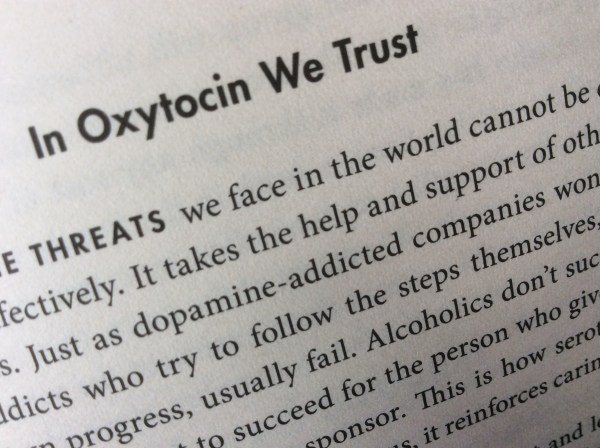
Sinek describes another two chemicals – serotonin and oxytocin – which are ‘selfless chemicals’. These chemicals encourage the strengthening of social bonds, foster connection and allow us to work together. I realised we needed more of these and I started to think of ways to introduce them.

My solution took the form of awards which provided recognition to those who went the extra mile. Not just in their work but in what they did for others. Achieving in this space provided the warm, fuzzy feeling we had been lacking, encouraging appreciation of each other and making people want to give back so others could share the love.

This idea operated on two levels – one for my team on a monthly basis and one for the organisation as part of our annual conference. The awards allowed colleagues to say thank you to each other for doing something nice which took the focus away from business results just for a moment. They rewarded the personal achievements like resilience, team work and being supportive.

It made the difference we needed. I didn’t put an end to the highs and who would want to? A dopamine rush is pretty amazing! But it did mean there was a little bit more of the cuddle drug flying around to create a sense of harmony.

Click here for a summary of Simon Sinek’s ‘Leaders Eat Last’.

Click here to watch Sinek explain the concept in person.

Or buy the book here: Leaders Eat Last: Why Some Teams Pull Together and Others Don’t

3minuteleadership.org

Why you should ditch the desk and flex your space

A few years ago, the new Chief Executive of the organisation I was working for had a bright idea to change the way we used the space in our office to get more from it. The way things were set out at the time meant that we had desks spread out across the office and often not all in use.  We were told we were going to reduce the number of desks which would give us space that we could use for commercial work.  We would all become ‘huggers’ or ‘hoppers’ and those in the latter category would have no use the desks or other areas flexibly.

If I’m honest, I wasn’t keen to give up my desk. It was my bit of personal space in the place I spend much of my time. Almost a home from home if you like. I’m not one for family photos in the workplace but I did have some personal things around my desk that I wasn’t keen to give up.

Although I was forced into it to start with, I’m now a complete convert. Once you have become used to working in this way and enjoyed the benefits, it’s hard to go back. I’ve now moved organisations and whilst I thought I would be pleased to have a desk of my own once again, I’m missing the ability to have fresh conversations with a wide range of people.

As a result, I am now looking to clear my desk and work more flexibly again.  One of the great things about being free to work in different spaces is the ability to share updates and ideas across teams and departments.  As I am looking to support colleagues across the whole organisation, this seems like a great way to achieve success by getting to know the people, their work and their environment.  It’s also a good way to encourage people to think and work outside of their silos. Those informal conversations are what build relationships and make people want to work together.

Being flexible in terms of space also allows greater efficiency because it empowers the individual to be where they need to be at that time to best get the job done instead of feeling pulled into a set place.

Personally, I like to work where I feel my ‘flow’.  Variety inspires me but also I like to choose my space according to how I feel or the task in hand.  If I need to be creative, I might look for a bright open space or if I need to do some quiet reading, you’re more likely to find me settled on a sofa somewhere.

Aside from getting to know people and priorities better, levels of trust can increase by developing a sense of a wider team. It’s also a great way to reduce the use of paper! When you don’t have a place to keep documents, you stop wanting to print them.

There have been some challenges to consider in adopting a new way of working in an organisation where this isn’t the norm.  The key to success is really around communication and getting support from those it affects.  People need to know how you intend to work and why, where you are and how they can get hold of you.  I make sure I keep my calendars to date and my phone number is shared so people can get hold of me easily.

Ultimately, it’s the 21st Century, teams are working differently and it’s time to push forward with the way we work to get the best results.
3minuteleadership.org

Blog at WordPress.com.

Up ↑