
Can You Ever Be Too Senior to Be Playful?

Recently, I attended a course for senior executives focused on people-centric change. To my delight, at the end of the session, the course leader introduced an improv game.

Improvisation is something I’ve been exploring because of its value in fostering creativity and flow. But not everyone shared my enthusiasm – some refused to join in, missing the point entirely. Perhaps they saw it as frivolous or worried about looking silly in front of their peers. Maybe a better introduction would have helped them see the benefits of this approach.

But here’s the thing—playfulness isn’t just for children. It’s a powerful tool for innovation, problem-solving, and connection. It can relieve stress, improve brain function and increase energy.

Some of the most effective leaders I know create environments where curiosity and experimentation thrive.

Eager to find out how improv could be applied in leadership, I signed up for a six-week course. I can’t say I’ll ever be an improv genius (some participants were incredible!), but stepping outside my comfort zone gave me new insights into how playfulness can unlock creativity and strengthen teams.

What Improv Taught Me About Effective Teams

  1. Building on ideas – The core principle of improv is “yes, and…” Instead of shutting down ideas, you expand on them. Imagine how different meetings would be if we all did this more!
  2. Active listening – You can’t build on ideas if you don’t truly listen. To listen actively is to pay full attention to the person speaking, understand their perspective, and respond thoughtfully. In improv, missing a single word can throw off an entire scene. In leadership and team work, failing to listen can mean missing opportunities for collaboration and innovation.
  3. Unleashing imagination – There’s something beautiful about tapping into creativity. As children, we do this instinctively; as adults, we often lose sight of this wonder. Yet, in business, creative thinking is invaluable – whether solving complex problems, inspiring teams, or developing fresh strategies. A global study found that 96% of survey respondents agree creative ideas are essential to an organization’s long-term success and performance so its seems worthwhile for leaders to explore their playful side.

Why This Matters for Leaders

Too often, leadership is associated with seriousness. But the best leaders know when to bring a sense of fun. They encourage exploration, create psychological safety, and make room for unexpected ideas. Some of the big corporate firms use improv techniques to spark creativity – Google famously uses “Yes, and…” exercises in team meetings. Pixar has storytelling improv sessions. These organisations understand that playfulness isn’t a distraction—it’s a catalyst for innovation.

There are plenty of great improv games available online, many of which can be done in person or virtually. They’re fantastic for energising teams, lightening the mood, and bringing creativity into problem-solving. Session Lab is a great place to look if you want to explore some new ideas.

So, can you ever be too senior to be playful? I don’t think so. If anything, the higher up you go, the more important it becomes.

Have you ever tried improv games with your teams? How did it go? Share your experiences in the comments below.

Image by Maike und Björn Bröskamp from Pixabay

From the Past to the Present: Leadership Lessons from Charity Adams and the 6888th Batallion

I’m inspired by women in non-traditional roles and WW2 is an interest I inherited from my Dad so I was excited for the new Netflix offer ‘The Six Triple Eight’.  The film tells the story of the first and only all-black unit of the women’s army corps which was led by Charity Adams who was the first African-American woman to become an Officer. With the level of racism and sexism in America in 1945, it seems an impossible feat.

Facing challenges at every step and deliberately set up with an impossible task, Charity had a determination that allowed her to become the highest ranking African-American woman by the end of the war. 

Her trailblazing journey highlights themes of inclusion, resilience, and effective leadership under pressure that are deeply relevant today. Here’s why her legacy continues to inspire and guide modern conversations about diversity and leadership:

1. Breaking Barriers in Leadership

Then: Charity Adams broke racial and gender barriers in a time when opportunities for Black women in leadership roles were virtually nonexistent. She led the “Six Triple Eight” to overcome systemic discrimination, logistical challenges, and the monumental task of sorting millions of pieces of undelivered mail to boost the morale of soldiers during the war.

Now: Her story underscores the importance of representation in leadership. Diverse leaders bring unique perspectives to problem-solving and decision-making, which are essential in today’s globalized and inclusive work environments.

2. Demonstrating Resilience and Excellence

Then: Despite facing racism, sexism, and immense pressure, Adams demanded excellence from herself and her team. She emphasized the value of discipline, collaboration, and purpose in achieving their mission.

Now: In modern workplaces, leaders must navigate complex challenges while fostering resilience in their teams. Adams’ example reminds us that adversity can be overcome through strategic thinking, strong leadership, and a commitment to the mission.

3. Advocating for Equity and Inclusion

Then: Adams proved that Black women could lead effectively in roles traditionally reserved for white men, challenging stereotypes and paving the way for future generations.

Now: Organizations still struggle with inequities in leadership opportunities for women and minority groups. Her example encourages leaders to actively address bias, create inclusive environments, and champion equitable opportunities.

4. The Power of Purpose-Driven Leadership

Then: Adams was not motivated by power or personal gain but by a sense of duty to her country and her team. Her purpose-driven leadership inspired her unit to achieve a seemingly impossible mission.

Now: Purpose-driven leadership resonates deeply in today’s world, where employees and stakeholders value leaders who prioritise social impact, ethical practices, and meaningful change.

5. Legacy as a Catalyst for Change

Then: Charity Adams’ story was not widely celebrated for decades, reflecting how the contributions of marginalized groups can be overlooked. Recent recognition highlights the need to acknowledge diverse histories.

Now: Her legacy serves as a call to action for modern leaders to recognize and amplify under-represented voices, ensuring that everyone has a seat at the table and their contributions are valued.

In today’s era, where diversity and inclusion are business imperatives, Charity Adams’ life offers timeless lessons on how to lead with integrity, resilience, and purpose. Her example encourages us to challenge systemic inequities, inspire others through our actions, and lead boldly in pursuit of a better, more inclusive future.

Charity Adams’ story reminds us that leadership is not about titles or power but about purpose, resilience, and inclusion. Her legacy challenges us to build workplaces and communities where everyone has the opportunity to lead and thrive.

If you’re looking to foster this kind of leadership in your own organisation or develop a culture where inclusion and resilience are at the forefront, I’d love to help. Through leadership development, culture support, and tailored coaching, I work with teams and individuals to inspire meaningful change and unlock their potential. Let’s connect and explore how we can create a better future together.

Leadership in the Wild: What Nature Teaches Us About Women in Power

The world has just witnessed the overwhelming defeat of Kamala Harris in the US election. In 2016, Hillary Clinton became the first woman in the US to win the popular vote, but this still wasn’t enough to secure the White House. In her concession speech, Clinton stated, “I know we have still not shattered that highest and hardest glass ceiling, but someday someone will.”

While the number of women in leadership roles is increasing, progress remains slow. Only 11% of FTSE 100 CEOs are women, and according to the UN, gender equality in the highest positions of power will not be achieved for another 130 years at the current rate. Furthermore, just 20% of presiding officers in parliaments worldwide are women.

In 2020, Smith et al. published a fascinating study examining female leadership in the animal kingdom to uncover insights that could help level the playing field for human leadership. The authors highlighted that attitudes about female leaders often reflect societal biases rather than actual performance. Prejudicial evaluations frequently cast women as less assertive, competitive, or independent than their male counterparts.

This bias extends to how women are perceived. For example, studies have found that people tend to prefer male voices over female ones—a phenomenon that famously led Margaret Thatcher to undergo voice coaching to sound less “shrill.” Men, too, are penalised for displaying traditionally feminine traits such as care and empathy, creating a rigid framework for leadership expectations.

What was the study?

The study focused on species with clearly defined leadership systems, identifying 8 out of 76 species with strong female leadership. This rarity—just 10% of the observed species—mirrors societal challenges in human leadership structures.

The findings revealed that primates, including monkeys, apes, and lemurs, predominantly exhibit masculine leadership, reflecting human preferences for male authority figures. Physical size was also identified as a barrier to female leadership, with smaller figures often failing to command the same level of authority.

Interestingly, female leadership tended to emerge in contexts requiring collective decision-making. For example, adult females with dependents often lead in species that rely on cooperative movement. In the human realm, mothers play a similar leadership role within families, but this critical skill set is rarely recognised or valued in professional settings.

Strong female leaders were more likely to succeed when they formed coalitions with others. Women’s leadership styles often centre on collaboration and uniting people around shared goals while navigating differences. This cooperative approach can be particularly effective in times of conflict.

Physical presence also plays a significant role in perceptions of leadership. Amy Cuddy’s research on body language highlights the importance of taking up space. In the human context, women are encouraged to “make themselves bigger” to project authority. The contrast between Hillary Clinton and Donald Trump during their election debates exemplifies this: Trump’s looming presence often overshadowed Clinton, both physically and metaphorically.

Finally, the study suggested that women are, on average, less motivated to engage in winner-take-all competitions for high-status positions. Those who do often feel pressure to adopt masculine traits to succeed, which can perpetuate a culture that discourages broader female participation.

What does this tell us about workplace culture?

The study demonstrates clear differences in how men and women lead, with feminine leadership often facing systemic challenges in human societies. At the same time, women’s collaborative and inclusive styles, whilst undervalued, have the potential to unite teams and deliver exceptional outcomes.

Organisations that fail to recognise and embrace these differences risk creating workplaces where conflict and stress persist, ultimately affecting business performance. By fostering an inclusive culture and creating space for diverse leadership approaches, organisations can unlock the full potential of their workforce and achieve greater harmony and success.

From this study, we can see that:

1) There are clear differences in the leadership of men and women with challenges for a typically feminine approach within human society. At the same time, there is evidence of key strengths in women’s leadership which, whilst appearing to be a softer approach, has the power to unite and support.

2) A lack of awareness of differences and the inability to create space for feminine approaches can lead to conflict in the workplace and significant challenges (and stress) for women leaders which ultimately impacts business performance.

3) Organisations that are serious about increasing female representation within their organisations, need to be aware of differences to support colleagues and ensure harmony so that colleagues can focus all of their efforts on achieving success. 

If you’d like support in increasing gender awareness and creating an inclusive culture, contact us for tailored advice and solutions.

Image: Tumisu via Pixabay

How to avoid ‘car crash’ conversations and make sure your feedback lands well every time

Have you ever received feedback that you reacted badly to?  Or tried to give someone else feedback and found they have flown off the handle? 

Feedback can be something people avoid because it can go in lots of different directions with so many of them not the route you wanted to take!

And yet, timely, constructive feedback is essential for the successful management of teams. It is also be critical for professional development so it is important that we create an environment where we can have open and honest feedback conversations which lead to better performance and development.

After a few car crash feedback discussions, I decided to find out more about the theory of good feedback and how to make sure I can deliver this effectively each time for the benefit of those in my team.


Types of feedback

The first thing to notice is that there are 3 different types of feedback.  All are important and you need to know the appropriate type to use in different situations and ensure that in your leadership practice, you are employing a balance of all types on a regular basis.

  1. Coaching – this type of feedback aims to help the receiver ‘expand knowledge, sharpen skill, improve capability’.  If you want to have a conversation about how an individual can improve, then coaching is a good way to go.  Beware though, a coaching approach is about asking questions (and the right kind of questions) to support the individual to explore the issue for themselves and come up with their own solution.  You can guide, you can support but you cannot ‘tell’ in a truly effective coaching conversation.
  2. Evaluation – this is to ‘rank against a set of standards’.  An example might be the classic performance review conversation where you are discussing how the individual has delivered against what was agreed.  It requires someone to rate an individual so for this to be effective, there needs to be agreement at the beginning about the measures they will be assessed against and support to help the individual meet expectations.  If you don’t provide this clarity and the individual scores badly, they will feel angry and frustrated which will lead to a difficult conversation and probably more to follow.
  3. Appreciation – this is feedback where effort, commitment and achievement is recognised.   You might also call this type of feedback ‘praise’ or ‘gratitude’.  Some leaders find this uncomfortable but it should be used often to motivate.  Appreciation encourages the   
    release of oxytocin which is important for connection and vital for building relationships and strong teams.

When feedback goes wrong…

We have to give feedback at times and even in the very best relationship, it can sometimes go wrong.  If you find that the receiver reacts emotionally, you can be sure that one of these triggers has been activated:

Truth trigger – it may be that the feedback appears untrue to the person on the receiving end. Maybe they think you don’t know what you are talking about and if this is the case, you could perhaps consider whether they are right and what you could do to build your own knowledge (being honest about your own weaknesses can also improve the conversation). 

The other possibility is that you have hit on a ‘blind spot’ which means they genuinely don’t see that the issue you raise is true of them.  It is not in line with their perception of reality and in this instance, a coaching approach could be beneficial to support them to explore the issue for themselves and allow yourself to understand it from their perspective.  If you are the receiver, you could test the feedback on people you trust which may help you to understand your blind spots in a safe space.

Relationship trigger – have you ever been in a relationship that has turned bad and everything you or they say leads to a negative response?  This can happen in work too. Having a good relationship is critical for successful feedback conversations.  If there is an issue with the relationship such as a lack of trust and respect, it is likely that the feedback will not land well.  Relationship triggers can create ‘switchtrack’ conversations where the receiver will retaliate by raising another issue they feel is related.  In this instance, it is important to recognise all issues and discuss them separately.  This will ensure both parties feel heard and respected.  If you notice this trigger, it might be worthwhile taking a step back, acknowledging the problem and taking steps to address the relationship issue.

Identity trigger – in this instance, the feedback is not in line with the individual’s perception of ‘self’ and challenges how they are wired.  For example, the receiver may be told that their actions were unfair when they believe that fairness is their core value.  An identity trigger can cause real distress so needs to be talked about openly to find out all points of view and help the individual understand how their actions have been perceived and if there is anything they could do differently in the future.   


How can you ensure feedback lands well every time?

Firstly, for feedback to land well every time, you need to have a good relationship where both parties feel comfortable to talk openly about their thoughts and feelings.  It is important to create a safe space for discussion where there is no judgement, only acceptance and constructive intent. 

Few people want to create conflict but sometimes the thought of giving feedback can lead to a situation where those involved enter the discussion already on the defensive.  The best attitude for a difficult conversation is a positive and constructive one which allows the problem to be discussed, addressed and resolved in partnership.

Whist a good relationship is important for feedback, so is feedback important for good relationships and strong teams so should be something we engage in at all levels on a regular basis.  If you create an environment where this can be shared constructively at all levels, you should have a space where everyone can thrive.

Do you have examples of good or bad feedback?  How have you ensured an environment where constructive discussions can take place?  Share your experiences in the comments below.


3minuteleadership.org

Photo credit: Gary Scott from Pixabay

Why becoming a great leader is a journey not a destination

One of my favourite leadership thinkers is Simon Sinek, author of Start with Why and Leaders Eat Last both of which you should read if you haven’t done so already.

The other week, I saw a link on Twitter to one of his videos which I watched and was reminded that ‘the best leaders don’t consider themselves to be experts; leadership is a skill which can be learned’.

This resonated with me because it is exactly the reason I am taking part in an initiative called ‘Leadership Pods’, a development programme developed by Dafydd Thomas at Circularis for people who want to be great leaders.

Being part of this encourages me to consider how I can further develop my leadership practice and allows me space to reflect on where I am now and where I would like to be in the future.  The programme also allows participants to share and learn from others who may have similar challenges or experiences.

As Sinek sets out, it is important as a leader to keep learning and commit to continuous improvement throughout your leadership journey.  It’s about supporting people and making a difference so why wouldn’t you want to work towards perfecting your craft which of course we all know does not have a final destination.

It’s like the best athlete working on their discipline; they can break new ground and set world records for their sport but there are always others who are watching them, learning from them and will ultimately take their place and set their own records.

Sinek goes so far as to say in his video: ‘any leader that considers themselves an expert… don’t trust them…. run in the other direction’.  You should definitely be suspicious of a leader who is convinced that they are always right and can’t see a reason to listen to the views or ideas of others.

In his book, Leaders Eat Last, Sinek promotes the importance within good leadership of prioritising the needs of others sometimes even putting these needs ahead of their own.  My approach certainly is to focus on supporting those in my teams, ensuring I take steps to understand their needs and considering how I can adapt my style to get the best out of them.

For example, I consider who they are and how they like to be managed.  Some people, particularly millennials, want to have autonomy; they want to be clear about what is expected of them and be given the freedom to do their best work which might involve trying out new ideas or generating new opportunities.  They expect to be able to get fully involved and don’t want to be told what to do.

Generation X and the baby boomers might prefer more specific management and direction  with greater clarity around what is expected of them and could even look for detailed instruction.  Of course people don’t always fit nicely into a box and so the only way you can understand what they need is to ask them.  I try to ask my direct reports on a regular basis if they are happy with the way they are being managed, recognising that my preferred style doesn’t work for everyone.  In circumstances where my approach is causing problems for them, I do my best to change it because ultimately, I want them to perform as well as they can and I don’t want to be the person that holds them back.

Understanding their long terms goals is also valuable because I recognise that they might not spend their whole career with one organisation and instead may wish to develop and move on to other opportunities.  In taking time to discuss this, I can ensure they are developing the necessary skills and experience to get them where they need to go.  Even if they do want to stay with us, I want that to be because they feel like they are able to develop and are invested in, whether that’s through funding for formal training or time to develop their specific interests or skills.

It’s important to recognise that they are a good measure of my own performance as a leader and I might ask them how they enjoy working with me and listen carefully to their feedback.  Also important is to recognise that they can be giving feedback through their silence or avoidance so I try to make a special effort to notice what they are not saying through body language or passing comments.

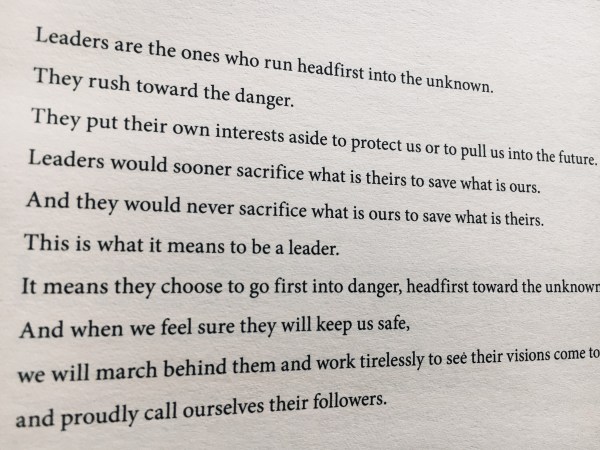
Sinek says: “We call them leader not because they are in charge but because they are willing to run head first into the unknown or dangerous.”

It’s not about status or rank, leadership is a skills that needs to be developed and perfected over time.  If you aspire to be a great leader then you might want to sign up for a Leadership Pod yourself and find out how you can unleash the power not only within yourself but in those you work with across your organisation.

Like a parent, you are not an expert parent but you keep practicing and practicing and hopefully, you’ll get it right someday.” (Simon Sinek)


Do you consider yourself to be a great leader? Have any thoughts or tips to share? Let us know what you think by posting in the comments below.


3minuteleadership.org


A hit of dopamine and sprinkling of oxytocin

Something that stood out for me when reading Simon Sinek’s ‘Leaders Eat Last’ was the section on chemicals in the body. In my previous organisation, my team was fortunate to be offered lots of fantastic opportunities which I encouraged them to take. This often pushed them out of their comfort zones, creating powerful feelings of challenge and achievement.

We had also introduced new organisational values at that time which encouraged ambition and, I felt, self-service. Whilst family and togetherness was the essence of one of the values, the others were in danger of encouraging competition amongst the team and whilst I want my teams to be driven, in this situation it felt like the balance was in danger of tipping in the wrong direction.

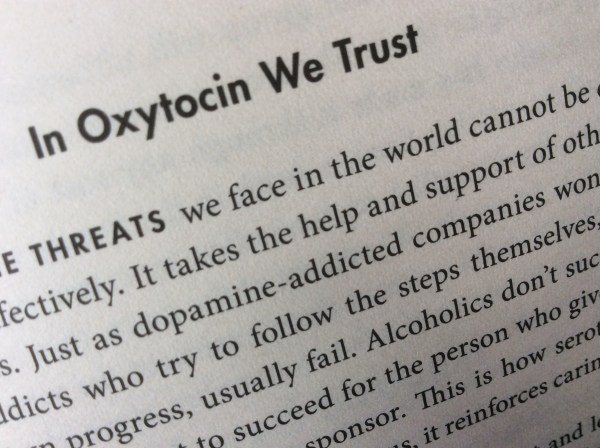
As I read the book, I realised that my team were high on dopamine and endorphins most of the time which feels great when you’re up but have a tendency to throw you down after the initial surge and make you want to chase the buzz these chemicals provide.

The opportunities in my area of work were amazing and we were all pleased to be able to enjoy this aspect but I did often feel exhausted by the highs and lows I experienced. The book also describes these chemicals as ‘selfish chemicals’ which push us to make progress but sometimes at the expense of others.

Sinek describes another two chemicals – serotonin and oxytocin – which are ‘selfless chemicals’. These chemicals encourage the strengthening of social bonds, foster connection and allow us to work together. I realised we needed more of these and I started to think of ways to introduce them.

My solution took the form of awards which provided recognition to those who went the extra mile. Not just in their work but in what they did for others. Achieving in this space provided the warm, fuzzy feeling we had been lacking, encouraging appreciation of each other and making people want to give back so others could share the love.

This idea operated on two levels – one for my team on a monthly basis and one for the organisation as part of our annual conference. The awards allowed colleagues to say thank you to each other for doing something nice which took the focus away from business results just for a moment. They rewarded the personal achievements like resilience, team work and being supportive.

It made the difference we needed. I didn’t put an end to the highs and who would want to? A dopamine rush is pretty amazing! But it did mean there was a little bit more of the cuddle drug flying around to create a sense of harmony.

Click here for a summary of Simon Sinek’s ‘Leaders Eat Last’.

Click here to watch Sinek explain the concept in person.

Or buy the book here: Leaders Eat Last: Why Some Teams Pull Together and Others Don’t

3minuteleadership.org

Blog at WordPress.com.

Up ↑