
From Fear to Freedom: Unlocking Your True Potential

What if fear of failure is the only thing standing between you and the life you actually want?

How many of us are afraid to put ourselves out there because we don’t want to fail? It’s a real dilemma – we don’t want to try something and look stupid so we can often just play it safe and stay in our lane. But progress and change require something different. It’s true that ‘outside of our comfort zone is where the magic happens’. So how can we build the courage and confidence to try?

In Amazon CEO, Andy Jassey’s top tips for success, he lists ‘don’t be afraid to fail’ as essential for invention. Inventing or re-inventing yourself is as important as anything else. Life has many chapters and we may need to invent ourselves many times. The key to pushing through a fear of failure is resilience and for me, a major part of resilience is learning.

Over the last couple of years, I have been going through my own reinvention with seismic shifts in my personal life leading to an adjustment in priorities. When this transition really hit a crisis point, I felt that my personal brand had fallen flat and I needed to really dig in to redefine my vision and goals.

It pushed me to develop my own consultancy offer and share my ideas with the world which is certainly outside of my comfort zone. There has been lots of trying new things and learning as I go. I’m very much on board with the idea that it is ‘better to ship passion than wait for perfection’ which is hard but I know that over time the approach will develop and whatever I do now, will transform gradually to become the final product.

Brené Brown puts Roosevelte’s ‘Man in the Arena’ quote at the heart of much of her work on vulnerability and I keep this close as I try new things. It basically says that the one who tries will either know the triumph of high achievement or ‘at the worst, if he fails, at least fails while daring greatly’ – the idea of this makes it much easier for me to push through the barriers.

Why are we afraid to fail? For many, failure connects to their self-worth and self-esteem. It’s the nervous system warning you of a threat and we want to avoid the shame and embarrassment of not achieving our goals.

Here are 3 things we can do to overcome the fear and remove barriers to success:

  1. Build a deep sense of self-worth – really work on you and know who you are. Focus on finding stability within yourself and understanding your worth on your own terms, not based on the validation of strangers.
  2. Identify what you are afraid of – consider what it is you want to do and identify what you are afraid of. Consider how likely it is that these things will happen, how others might perceive the ‘failure’ (it is often not the way you think!) and what you can put in place to reduce the risk of things not working out.
  1. Focus on the learning – think through in advance what you can learn if it doesn’t go exactly as you planned. Manage your expectations and consider next steps so that you can build or pivot if you don’t achieve your ideal outcome.

I’ve seen many people miss out on opportunities because they feel the fear and let it dominate their actions so whatever it is you dream of, consider how you can just get started and ‘do the thing!’.

Have you let fear hold you back? Or have you been able to learn from failure? I’d love to hear your story! Drop it in the comments and let’s learn from each other.

Image: Pete Linforth from Pixabay
Why mistakes and failure are critical for success

This week, I’ve been thinking a lot about how we learn and what we need to have in place to support this process.  Something that has become obvious to me in exploring this idea is that a critical part of learning is allowing space for error. 

It’s something that troubles us all too often.  When we get that major project, we might feel excitement and elation to start off with but that can quickly turn to anxiety and stress as we worry that we might fail or make mistakes.

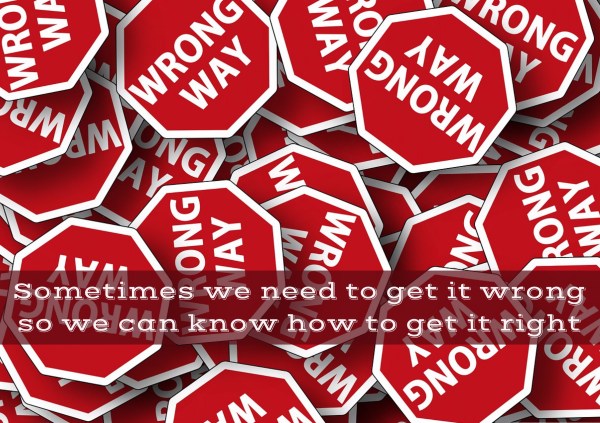
It can be crippling sometimes and really hold people back if they do not feel comfortable or supported to take a chance on something that at best could bring huge dividends but at worst, we might feel it could affect our credibility or damage our reputation.  The thing is though, mistakes and failure are critical for success.  Sometimes, we need to get it wrong so that we can know how to get it right.

If we consider learning and how this takes place, we can see it takes a number of forms.  Firstly, we are all used to learning by being taught.  Most of us have grown up in a classroom being told by a teacher how things are and what we should do.  Secondly, we can go and find information previously through reading books and mostly now by accessing the internet – Google knows everything, right?!!

And Google has often provided me with the answers and ideas I need to make things happen and keep on track.  In today’s world, people love to share and so we can find out the major pitfalls in advance and try to make sure these don’t happen within our project.

Looking in the dictionary for a clear definition of learning it does indeed include these two things but it also includes another major vehicle for learning and that is experience.  The first learning we do as a baby or a toddler is through trial and error.  For example, how do we learn to walk?  By trying it and falling down A LOT of times!!  Eventually, most babies manage to find balance and walk for themselves without falling over although this can take some time and we can still forget sometimes or get it wrong and lose our step.

In terms of the workplace, one of the key things that stuck with me from my study of political philosophy back in the day is taken from John Stuart Mill’s arguments around free speech.  He says that everyone needs to be able to have their say because if they are allowed to express their opinion, then it can be discussed alongside any counter arguments and ultimately, if they are then persuaded they are wrong then the learning is greater.

 “If the opinion is right, they are deprived of the opportunity of exchanging error for truth: if wrong, they lose, what is almost as great a benefit, the clearer perception and livelier impression of truth, produced by its collision with error.”  (On Liberty, John Stuart Mill)

It’s the same for making mistakes.  As children, how many of us were confronted with a naked flame and told not to touch it because it’s hot?  And how many of us touched it anyway because we needed to learn for ourselves?  The learning is greater from touching the flame than being told not to.

There’s a reason we have sayings like ‘we learn from our mistakes’ or ‘you live and learn’.  It’s because we are programmed to learn by doing and we need to do so to fully experience the world and all it has to offer.  Learning in this way means it won’t all go smoothly and we may fall down from time to time but getting comfortable with getting it wrong is absolutely key to success.


Do you have an example of learning through mistakes at work? Are you a Manager or CEO in an organisation that encourages people to try new things even if it might go wrong? Tell us your tory in the comments below.


3minuteleadership.org


Blog at WordPress.com.

Up ↑