From the Past to the Present: Leadership Lessons from Charity Adams and the 6888th Batallion

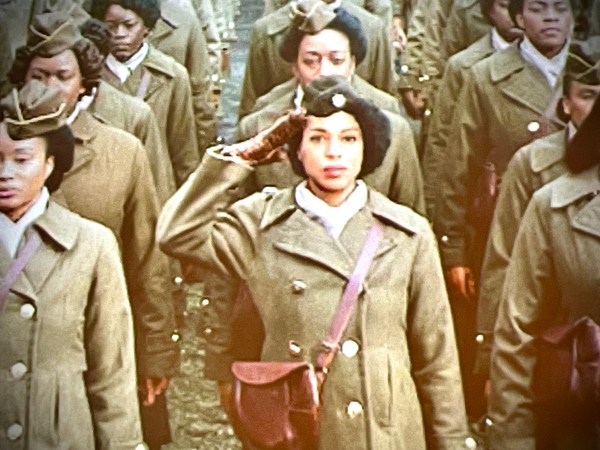
I’m inspired by women in non-traditional roles and WW2 is an interest I inherited from my Dad so I was excited for the new Netflix offer ‘The Six Triple Eight’.  The film tells the story of the first and only all-black unit of the women’s army corps which was led by Charity Adams who was the first African-American woman to become an Officer. With the level of racism and sexism in America in 1945, it seems an impossible feat.

Facing challenges at every step and deliberately set up with an impossible task, Charity had a determination that allowed her to become the highest ranking African-American woman by the end of the war. 

Her trailblazing journey highlights themes of inclusion, resilience, and effective leadership under pressure that are deeply relevant today. Here’s why her legacy continues to inspire and guide modern conversations about diversity and leadership:

1. Breaking Barriers in Leadership

Then: Charity Adams broke racial and gender barriers in a time when opportunities for Black women in leadership roles were virtually nonexistent. She led the “Six Triple Eight” to overcome systemic discrimination, logistical challenges, and the monumental task of sorting millions of pieces of undelivered mail to boost the morale of soldiers during the war.

Now: Her story underscores the importance of representation in leadership. Diverse leaders bring unique perspectives to problem-solving and decision-making, which are essential in today’s globalized and inclusive work environments.

2. Demonstrating Resilience and Excellence

Then: Despite facing racism, sexism, and immense pressure, Adams demanded excellence from herself and her team. She emphasized the value of discipline, collaboration, and purpose in achieving their mission.

Now: In modern workplaces, leaders must navigate complex challenges while fostering resilience in their teams. Adams’ example reminds us that adversity can be overcome through strategic thinking, strong leadership, and a commitment to the mission.

3. Advocating for Equity and Inclusion

Then: Adams proved that Black women could lead effectively in roles traditionally reserved for white men, challenging stereotypes and paving the way for future generations.

Now: Organizations still struggle with inequities in leadership opportunities for women and minority groups. Her example encourages leaders to actively address bias, create inclusive environments, and champion equitable opportunities.

4. The Power of Purpose-Driven Leadership

Then: Adams was not motivated by power or personal gain but by a sense of duty to her country and her team. Her purpose-driven leadership inspired her unit to achieve a seemingly impossible mission.

Now: Purpose-driven leadership resonates deeply in today’s world, where employees and stakeholders value leaders who prioritise social impact, ethical practices, and meaningful change.

5. Legacy as a Catalyst for Change

Then: Charity Adams’ story was not widely celebrated for decades, reflecting how the contributions of marginalized groups can be overlooked. Recent recognition highlights the need to acknowledge diverse histories.

Now: Her legacy serves as a call to action for modern leaders to recognize and amplify under-represented voices, ensuring that everyone has a seat at the table and their contributions are valued.

In today’s era, where diversity and inclusion are business imperatives, Charity Adams’ life offers timeless lessons on how to lead with integrity, resilience, and purpose. Her example encourages us to challenge systemic inequities, inspire others through our actions, and lead boldly in pursuit of a better, more inclusive future.

Charity Adams’ story reminds us that leadership is not about titles or power but about purpose, resilience, and inclusion. Her legacy challenges us to build workplaces and communities where everyone has the opportunity to lead and thrive.

If you’re looking to foster this kind of leadership in your own organisation or develop a culture where inclusion and resilience are at the forefront, I’d love to help. Through leadership development, culture support, and tailored coaching, I work with teams and individuals to inspire meaningful change and unlock their potential. Let’s connect and explore how we can create a better future together.

Leadership in the Wild: What Nature Teaches Us About Women in Power

The world has just witnessed the overwhelming defeat of Kamala Harris in the US election. In 2016, Hillary Clinton became the first woman in the US to win the popular vote, but this still wasn’t enough to secure the White House. In her concession speech, Clinton stated, “I know we have still not shattered that highest and hardest glass ceiling, but someday someone will.”

While the number of women in leadership roles is increasing, progress remains slow. Only 11% of FTSE 100 CEOs are women, and according to the UN, gender equality in the highest positions of power will not be achieved for another 130 years at the current rate. Furthermore, just 20% of presiding officers in parliaments worldwide are women.

In 2020, Smith et al. published a fascinating study examining female leadership in the animal kingdom to uncover insights that could help level the playing field for human leadership. The authors highlighted that attitudes about female leaders often reflect societal biases rather than actual performance. Prejudicial evaluations frequently cast women as less assertive, competitive, or independent than their male counterparts.

This bias extends to how women are perceived. For example, studies have found that people tend to prefer male voices over female ones—a phenomenon that famously led Margaret Thatcher to undergo voice coaching to sound less “shrill.” Men, too, are penalised for displaying traditionally feminine traits such as care and empathy, creating a rigid framework for leadership expectations.

What was the study?

The study focused on species with clearly defined leadership systems, identifying 8 out of 76 species with strong female leadership. This rarity—just 10% of the observed species—mirrors societal challenges in human leadership structures.

The findings revealed that primates, including monkeys, apes, and lemurs, predominantly exhibit masculine leadership, reflecting human preferences for male authority figures. Physical size was also identified as a barrier to female leadership, with smaller figures often failing to command the same level of authority.

Interestingly, female leadership tended to emerge in contexts requiring collective decision-making. For example, adult females with dependents often lead in species that rely on cooperative movement. In the human realm, mothers play a similar leadership role within families, but this critical skill set is rarely recognised or valued in professional settings.

Strong female leaders were more likely to succeed when they formed coalitions with others. Women’s leadership styles often centre on collaboration and uniting people around shared goals while navigating differences. This cooperative approach can be particularly effective in times of conflict.

Physical presence also plays a significant role in perceptions of leadership. Amy Cuddy’s research on body language highlights the importance of taking up space. In the human context, women are encouraged to “make themselves bigger” to project authority. The contrast between Hillary Clinton and Donald Trump during their election debates exemplifies this: Trump’s looming presence often overshadowed Clinton, both physically and metaphorically.

Finally, the study suggested that women are, on average, less motivated to engage in winner-take-all competitions for high-status positions. Those who do often feel pressure to adopt masculine traits to succeed, which can perpetuate a culture that discourages broader female participation.

What does this tell us about workplace culture?

The study demonstrates clear differences in how men and women lead, with feminine leadership often facing systemic challenges in human societies. At the same time, women’s collaborative and inclusive styles, whilst undervalued, have the potential to unite teams and deliver exceptional outcomes.

Organisations that fail to recognise and embrace these differences risk creating workplaces where conflict and stress persist, ultimately affecting business performance. By fostering an inclusive culture and creating space for diverse leadership approaches, organisations can unlock the full potential of their workforce and achieve greater harmony and success.

From this study, we can see that:

1) There are clear differences in the leadership of men and women with challenges for a typically feminine approach within human society. At the same time, there is evidence of key strengths in women’s leadership which, whilst appearing to be a softer approach, has the power to unite and support.

2) A lack of awareness of differences and the inability to create space for feminine approaches can lead to conflict in the workplace and significant challenges (and stress) for women leaders which ultimately impacts business performance.

3) Organisations that are serious about increasing female representation within their organisations, need to be aware of differences to support colleagues and ensure harmony so that colleagues can focus all of their efforts on achieving success. 

If you’d like support in increasing gender awareness and creating an inclusive culture, contact us for tailored advice and solutions.

Image: Tumisu via Pixabay

Power, Progress, and Patriarchy: Lessons on Culture from the US Election

When I went to bed last night, it was with a feeling of hope that I might wake up with a mixed-race woman as the leader of the free world. The idea was exciting because it sends such a powerful message to all women about leadership and culture. Alas, it was not to be. 

It reminds me of a key lesson from my course with Aberdeen University exploring organisational culture and conflict. The thing I noticed from the very first lecture was that culture is essential for inclusion. I’d say that a common mistake for organisations is to make a bold commitment to EDI, setting goals and indicators without doing the culture work required for success.

The US election result highlights the tensions in society around equality and change. What we have seen in America is a choice between masculine and feminine cultures and what we have learnt is that patriarchy is alive and well.

Watching Harris on the campaign trail, I saw an intelligent, warm, empathetic leader who could speak to all and bring unity. She came across as honest and credible, with a professionalism fitting for a world leader.

Trump on the other hand is clearly a highly controversial figure who bases his approach on the masculine values of power and status. 

Hofstede’s cultural theory suggests that in a masculine society, gender roles are distinct. The belief in this culture is that men should be assertive, tough and focused on material success. In such a society, men ’hold more positions of power, get paid more and are expected to act in a masculine manner‘.

By contrast, feminine cultures have no such divides with men and women equally concerned with quality of life. Feminine cultures tend to have loose gender roles, equal pay, female representation in most positions of power, and quality of life and relationships with people are valued over status and wealth.

Whilst individualism vs collectivism represents a separate cultural dimension, it does seem to me that this election result represents individuals concerned with self-interest which is in conflict with the more caring, nurturing feminine approach which might be more collectivist.

Culture develops from history so whatever the original model of a nation or organisation, this will inform views and beliefs. Looking more into this, the values attributed to America are justice, freedom, equality, democracy and compassion. Let’s be honest though, perception has a role to play here – some have been free and equal for longer than others!

If you listen to the powerful speech from John Legend and Common at the 2015 Oscar award ceremony, you will hear them speak passionately about the continued struggle for justice in America and around the world (listen from 2.28)

So for many today, the election result will seem like an historic day for equality and social justice in a very damaging way. For all those campaigners and activists feeling tired and drained today, it’s a night for pizza and pyjamas. Tomorrow, the work continues. Here is a gift to inspire us all and bring courage and strength: ‘Still I Rise’ by Maya Angelou (1987, Live performance)

Does this resonate with you or do you have a different perspective? Whatever your views, feel free to share in the comments below.

Women Leaders

[Guest post by Hilarie Owen]


Most organisations are aware of gender inequality and many are trying to address the issue with training programmes, coaching and trying to build a pipeline but these actions are not delivering the results quick enough. Filling the pipeline hasn’t produced the results and neither have policies. The barriers that hinder progress for women are far more complex and elusive. 

Following my webinar on women, power and leadership that was held on International Women’s Day 2018 with three great speakers I decided to explore women leaders in more depth. I interviewed women leaders across society from business, the arts, science, technology and government. I was enthralled by their autobiographical narratives. Their stories were engaging and it became clear that their leadership emerged and grew from their experiences. It quickly unfolded that there were key patterns that were central to their ability to lead that I will try and capture in my new book. One of the noticeable things was that in 30 interviews I did not find one ego. In fact these women were like you and me so we can’t say ‘Ah, but they are different’.

Each woman, regardless of their background or education, had common elements they had developed. It wasn’t as simple as qualities, as important as these are, but constructs they had combined to form their leadership – a different form of leadership to the older male version.

I’ve been immersed in what makes great leaders for the last 20 years, helping to inspire high performance in top teams around the world, including my research with the RAF’s Red Arrows. Women are doing amazing things in business, the military, politics, sports and the arts. Yet the number of occupying senior posts is falling.  Globally, while women are receiving higher education gender parity is shifting backwards for the first time since 2006, according to the 2017 Global Gender Gap Report and what stands out is that although women across the world are highly educated the workplace is still not give them parity.

In the UK, more women are joining boards as Non-Executive Directors but this has become more of a tick box exercise as the numbers of full time women directors remain static. According to a report from Grant Thornton in 2017, the number of women coming through into senior management posts is actually declining. How can this possibly be? Surely we already have the policies and procedures we need in place. The solution isn’t to ‘fix women’ but to fix the barriers in organisations. So the book not only focuses on women leaders but how to enable organisations to be far more inclusive. The book will be launched in the Spring but people can pre-order copies now by going to:

https://www.kickstarter.com/projects/614479735/welead-women-leaders-and-inclusive-organisations?ref=project_build
So far, I have written eight books on leadership that sell around the world opening up opportunities to work in different countries. Everywhere I meet inspiring women who are doing amazing work and campaigning for more opportunities for women.  My aim is quite clear. One day when someone asks women ‘what do you do? The answer will be ‘weLEAD’.


© Hilarie Owen  hilarie.owen@iofl.org

3minuteleadership.org

Blog at WordPress.com.

Up ↑