
Can You Ever Be Too Senior to Be Playful?

Recently, I attended a course for senior executives focused on people-centric change. To my delight, at the end of the session, the course leader introduced an improv game.

Improvisation is something I’ve been exploring because of its value in fostering creativity and flow. But not everyone shared my enthusiasm – some refused to join in, missing the point entirely. Perhaps they saw it as frivolous or worried about looking silly in front of their peers. Maybe a better introduction would have helped them see the benefits of this approach.

But here’s the thing—playfulness isn’t just for children. It’s a powerful tool for innovation, problem-solving, and connection. It can relieve stress, improve brain function and increase energy.

Some of the most effective leaders I know create environments where curiosity and experimentation thrive.

Eager to find out how improv could be applied in leadership, I signed up for a six-week course. I can’t say I’ll ever be an improv genius (some participants were incredible!), but stepping outside my comfort zone gave me new insights into how playfulness can unlock creativity and strengthen teams.

What Improv Taught Me About Effective Teams

  1. Building on ideas – The core principle of improv is “yes, and…” Instead of shutting down ideas, you expand on them. Imagine how different meetings would be if we all did this more!
  2. Active listening – You can’t build on ideas if you don’t truly listen. To listen actively is to pay full attention to the person speaking, understand their perspective, and respond thoughtfully. In improv, missing a single word can throw off an entire scene. In leadership and team work, failing to listen can mean missing opportunities for collaboration and innovation.
  3. Unleashing imagination – There’s something beautiful about tapping into creativity. As children, we do this instinctively; as adults, we often lose sight of this wonder. Yet, in business, creative thinking is invaluable – whether solving complex problems, inspiring teams, or developing fresh strategies. A global study found that 96% of survey respondents agree creative ideas are essential to an organization’s long-term success and performance so its seems worthwhile for leaders to explore their playful side.

Why This Matters for Leaders

Too often, leadership is associated with seriousness. But the best leaders know when to bring a sense of fun. They encourage exploration, create psychological safety, and make room for unexpected ideas. Some of the big corporate firms use improv techniques to spark creativity – Google famously uses “Yes, and…” exercises in team meetings. Pixar has storytelling improv sessions. These organisations understand that playfulness isn’t a distraction—it’s a catalyst for innovation.

There are plenty of great improv games available online, many of which can be done in person or virtually. They’re fantastic for energising teams, lightening the mood, and bringing creativity into problem-solving. Session Lab is a great place to look if you want to explore some new ideas.

So, can you ever be too senior to be playful? I don’t think so. If anything, the higher up you go, the more important it becomes.

Have you ever tried improv games with your teams? How did it go? Share your experiences in the comments below.

Image by Maike und Björn Bröskamp from Pixabay

Better every time: U6s coaching & performance

For a while I wasn’t sure if I would ever become a mum. And I really didn’t anticipate that I would become a Sunday morning football mum.

So, as I am standing outside on a crisp and sunny Sunday morning cheering on the under sixes, I am observing all the benefits of playing the sport. In particular, I am noticing how the coaches getting the most out of our young players.

It is making me think about how the focus and techniques of these coaches can apply to coaching for performance in the workplace.

Here are the top tips, I have picked up from watching a group of 5 year olds in the first proper football match:

Positivity – the first thing I noticed is, it’s all really upbeat. The tone, the body language and the spoken communication. It is all very much concentrated on engaging the players and keeping them focused.

Enthusiastic – feedback from the coach tells them how well they’re doing. Im hearing lots of ‘well done’, ‘let’s keep it going’ and ‘you are getting better and better’.

Focused – the communication is focused on what is going to happen and what the coach wants them to do. The instructions are simple and clear.

Expectations – there is clarity of expectations. Stopping when needed and making sure the children have understood what is not negotiable e.g. Shaking hands with the other team at the end of the game.

Praise and recognition – there is lots of individual and team praise. Identifying individuals and telling them when they have done well. And telling the team when they doing well as a group. Lots of ‘well played’, ‘that’s really good’, ‘great tackle’ and so on.

It is a worthwhile reminder of how to lead teams in the workplace. The coaches here are all volunteers and they are doing an amazing job of bringing together lots of lively under sixes to focus on a shared goal. The kids are learning lots of important lessons for life set as how to be resilient and support your team.

So whilst it’s an early and cold start to my Sunday, I am really enjoying the learning that I’m taking from it and thinking how I can bring more of this back to achieve even greater success within my own organisation.

Are you a school mum or dad? Do you and similar learning from your children’s sports? Tell us about it in the comments below.

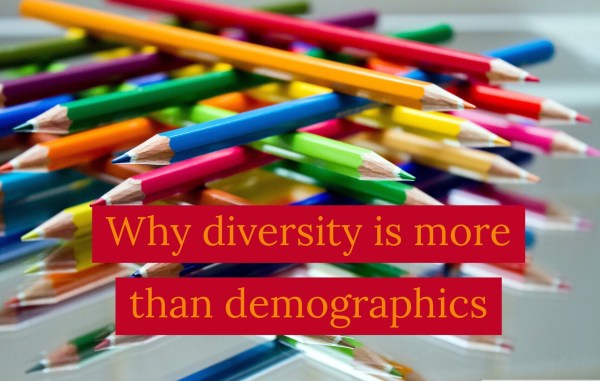
Why diversity is more than demographics

When I first became a Manager, I had one member of staff in my team.  She was my antithesis.  Completely the opposite of me.  I didn’t understand her way of working or why it was so difficult and I found it very frustrating.  She would focus on the minute details, take her time over things and make sure everything was exactly right.  In contrast, I support the Facebook mantra of ‘done is better than perfect’.  That doesn’t mean a lack of standards but I’m not looking for the best piece of work ever but sometimes if you spend too long making it perfect, you end up missing the moment.

Not long after we had begun working together, I went on a training course about emotional intelligence and it was there that I had a light bulb moment.  We did an activity about working styles and in doing this, I realised that my colleague was a ‘be perfect’ whereas I’m a ‘hurry up’.  As soon as I realised that, my approach changed and we had a much more successful working relationship from there on in.  By the time she left the organisation, I had learnt that the opposite skills that she brought to the team were exactly what I needed and once I was back to working with someone similar to myself, I felt a loss of skills that had been extremely valuable.

Today, I deliberately look for difference when hiring people.  It might be tempting to recruit in my own image and it can be easier to work with others who think the same way that you do and take the same approach but I now understand the true value of diversity and aim to construct a team where each individual brings something different and can shine in their own right.  My current team is a fantastic example of this – individually unique and perfect together.  They each bring something to the party which makes for endless good times!

Often when we talk about diversity we think about demographics – sex, race, age, ability – and this is extremely important but I do think it’s more than that.  In my view, we need to think about difference more broadly and recognise the value of bringing people, views and skills together.  The reason diversity is said to be good for business is that it brings a variety of viewpoints and a wider range of experience which improves decision making and problem solving .  An article published in The Guardian claims that ‘unconscious bias and a tendency to hire in their own image can lead managers to bring in the wrong candidate for their team ’ and suggests that ‘a lack of diversity is one of the biggest issues threatening the advertising industry today, challenging the credibility of the industry and preventing businesses from being run as effectively as they could be’.   The advice in this article is to ‘consider each hire based on the value they can add to the team, rather than simply in a specific role. It is not always about hiring the best person for the role, rather the best person for the team as a whole’.

Keep an eye on the skills in the team and consider what’s missing.  Then when you recruit in the future you can look for someone who will add value to the team rather than bringing what you already have.

Have you got your own stories about the benefits of having a diverse team?  Can you relate to the experiences above or do you have your own which challenge this view?  Let us know in the comments below.


If you want to understand the roles in your team or find out if you have unconscious bias, try these tools:


www.3minuteleadership.org 


Photo: Pixabay.com


A hit of dopamine and sprinkling of oxytocin

Something that stood out for me when reading Simon Sinek’s ‘Leaders Eat Last’ was the section on chemicals in the body. In my previous organisation, my team was fortunate to be offered lots of fantastic opportunities which I encouraged them to take. This often pushed them out of their comfort zones, creating powerful feelings of challenge and achievement.

We had also introduced new organisational values at that time which encouraged ambition and, I felt, self-service. Whilst family and togetherness was the essence of one of the values, the others were in danger of encouraging competition amongst the team and whilst I want my teams to be driven, in this situation it felt like the balance was in danger of tipping in the wrong direction.

As I read the book, I realised that my team were high on dopamine and endorphins most of the time which feels great when you’re up but have a tendency to throw you down after the initial surge and make you want to chase the buzz these chemicals provide.

The opportunities in my area of work were amazing and we were all pleased to be able to enjoy this aspect but I did often feel exhausted by the highs and lows I experienced. The book also describes these chemicals as ‘selfish chemicals’ which push us to make progress but sometimes at the expense of others.

Sinek describes another two chemicals – serotonin and oxytocin – which are ‘selfless chemicals’. These chemicals encourage the strengthening of social bonds, foster connection and allow us to work together. I realised we needed more of these and I started to think of ways to introduce them.

My solution took the form of awards which provided recognition to those who went the extra mile. Not just in their work but in what they did for others. Achieving in this space provided the warm, fuzzy feeling we had been lacking, encouraging appreciation of each other and making people want to give back so others could share the love.

This idea operated on two levels – one for my team on a monthly basis and one for the organisation as part of our annual conference. The awards allowed colleagues to say thank you to each other for doing something nice which took the focus away from business results just for a moment. They rewarded the personal achievements like resilience, team work and being supportive.

It made the difference we needed. I didn’t put an end to the highs and who would want to? A dopamine rush is pretty amazing! But it did mean there was a little bit more of the cuddle drug flying around to create a sense of harmony.

Click here for a summary of Simon Sinek’s ‘Leaders Eat Last’.

Click here to watch Sinek explain the concept in person.

Or buy the book here: Leaders Eat Last: Why Some Teams Pull Together and Others Don’t

3minuteleadership.org

Blog at WordPress.com.

Up ↑